Interview · Art
Thangka: Painting the Roadmap to Enlightenment
An interview with thangka master painter and teacher Ambar Lama on the state of this iconic Tibetan art.
Jon DeHart·The Diplomat
An interview with thangka master painter and teacher Ambar Lama on the state of this iconic Tibetan art.
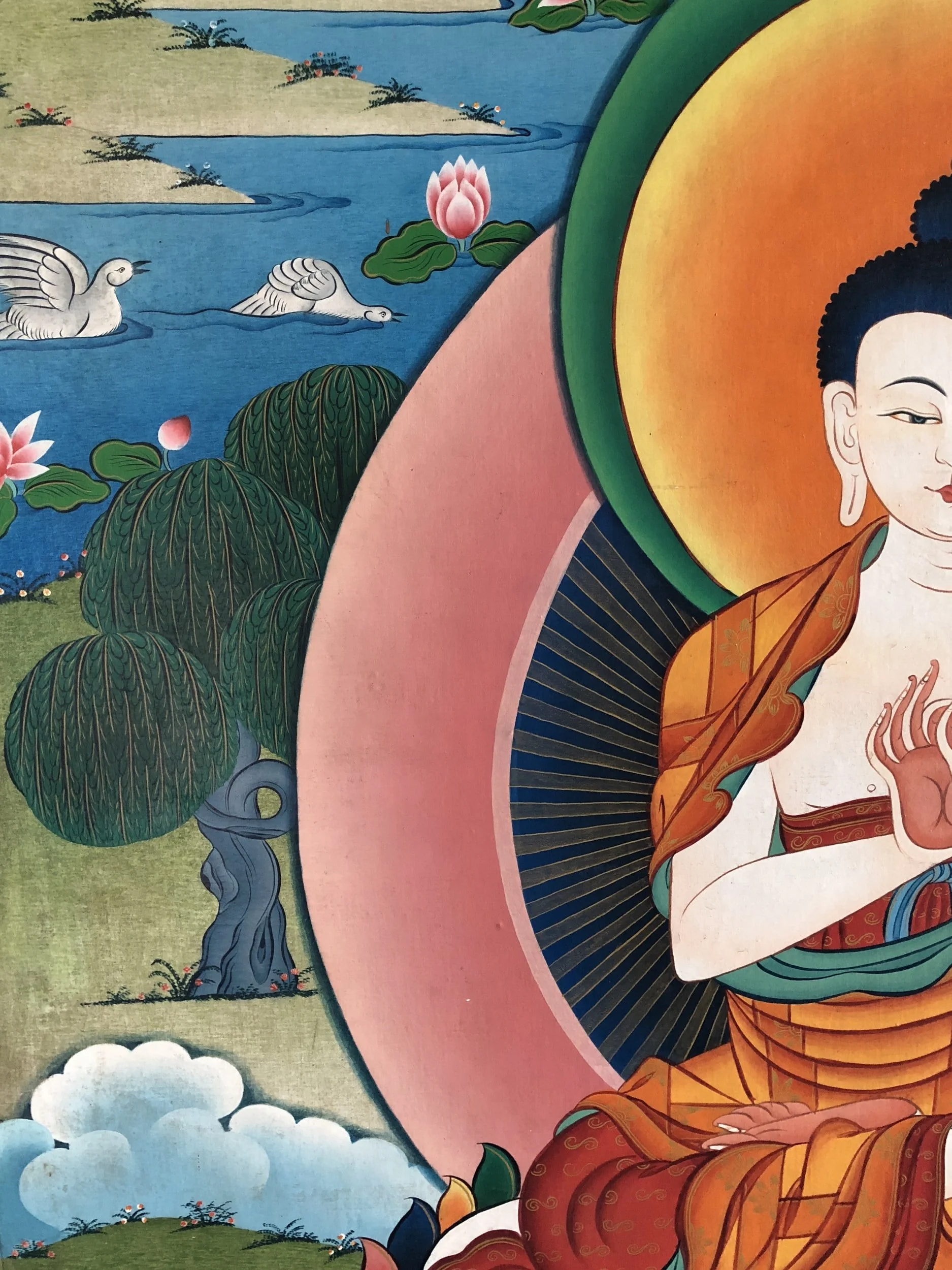
From peaceful deities such as the 1,000-armed Avalokiteshvara and Goddess Tara to gods at the wrathful end of the scale — Yama, the god of death often enshrouded in flames; the war goddess Begtse — to mathematical mandalas and more, Tibetan Buddhism has been visually expressing its core insights for centuries via an intricate style of sacred art known as thangka.
Literally "recorded message" in Tibetan, thangka paintings are the medium and the message for Buddhists across the Himalayas, from Tibet to Nepal. Drawing on Indian, Nepalese, Chinese and Kashmiri influences, thangka grew into its own style in the seventh century. Normally taking the form of a scroll, thangka are painted or embroidered onto linen, cotton, or silk, employing animal glue and naturally occurring pigments such as malachite, cinnabar and lapis lazuli.
Following a complex grid system, thangka artists must draw each figure and frill according to precise measurements and proportions stipulated by Buddhist iconography. In this sense, the role of the artist is quite different from the inventor we know in the West.
"The role of the artist becomes one of a medium or channel, who rises above his own mundane consciousness to bring a higher truth into this world."
This results in paintings with an almost mathematical level of precision and symmetry, particularly in the more complex mandala patterns, which are meant to encapsulate the entire universe in a single frame. Depending on scale and intricacy, a given painting can keep a team of artists busy for months or even years before it is complete. The Diplomat recently spoke with Ambar Lama, who helped found the Old Tibetan Thangka Painting Academy, from his shop in Kathmandu.
How did you learn to paint in the thangka style?
I started studying when I was 7 years old under my father. I learned from my uncle also. I'm 30 now, but I'm still learning. I come from a mixed family of lama lineage — my father is Tibetan and my mother is Nepali. My younger brother is 22 and already a master painter, with 14 years of experience. For perspective, my uncle has 35 years of experience. He is a highly advanced master and an amazing teacher.
Is the skill passed down within a family, or can anyone go to a school and learn?
In fact, it's a very rare thing to see a thangka school in Nepal. Most people learn from family elders. But there is no rule saying that someone without family ties to the art can't learn to paint in the thangka style. Anyone can choose to be an artist. They don't have to come from a lama family.
In the full interview, Lama describes the free school he founded in Kathmandu, what makes thangka spiritually unique, how a single painting can change a life — and how earthquakes, border politics and a weak tourist season have pushed Himalayan painters to the brink.
Continue reading at The Diplomat →