Music · Culture
Punk in Asia: Rebelling from Burma to Beijing
Although punk rock may have lost its edge in the West, it is alive and kicking in much of Asia.
Jon DeHart·The Diplomat
Although punk rock may have lost its edge in the West, it is alive and kicking in much of Asia.
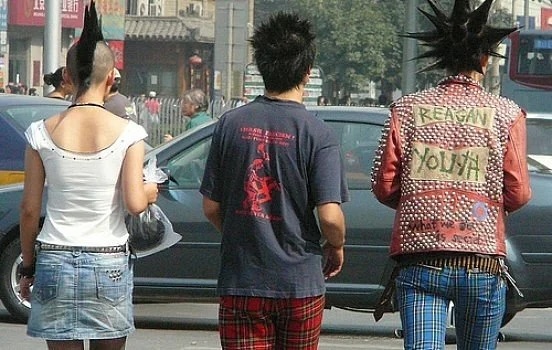
Punk rock has many faces. Wherever it flourishes, the media tends to focus on its visual cues: angst-ridden mohawked youths, tattoos, piercings, loud-colored clothing, spikes, chains, black leather. While punk may have become watered down in its places of origin, elsewhere in the world — from Indonesia and Russia to Iraq and Burma — it has taken root as a relevant and very alive form of dissent.
Nowhere is punk more vital today than Burma, where the community has been coming out from the underground, where it remained in hiding during decades of rule by a ruthless military junta. Istanbul-born photographer Pari Dukovic captured Burmese youth in full punk attire taking more openly to Yangon's streets since the dictatorship officially faded from view in 2011.
But dig deeper and you'll discover powerful socio-political undercurrents. A comparison with the punk that surfaced in 1970s New York is telling. As the introduction to Dukovic's portfolio notes, "Punk in nineteen-seventies New York tended to be more concerned with aesthetics than with politics. Often, the 'establishment' it railed against was your mom, or your school principal."
"The punks I met in Burma were beyond just wearing the fashion — they truly had an ideology and something that they strongly believed in."
Of the early days, Yangon punk Darko, who sings in the band Side Effect, recalled: "You could get thrown into jail over nothing. The police used to pick up the punks and beat them up for no reason, and shave off their hair." The level of oppression has inspired strong feelings of dissent. Take the lyrics of a band called The Rebel Riot: "No fear! No indecision! / Rage against the system of the oppressors!"
Even as the government slowly loosens its grip, homegrown acts like The Rebel Riot and No U Turn still face repression. When compared to the poppy consumer brand of punk that has evolved in the West, this raises a question: can authentic punk — or counterculture in any form — only flourish in oppressive environments?
The full piece turns to China — a Shanghai band banned for eight months over one viral song, even as Johnny Rotten was free to play Beijing — and the subtler obstacle to an organic scene: the absence of a legal framework to build one.
Continue reading at The Diplomat →