Folklore · Culture
Mermaids of Asia: Dugongs, Dragon Wives and the Deep
Although the mermaid mythos is normally thought to be Western, it runs deep in Asia too.
Jon DeHart·The Diplomat
Although the mermaid mythos is normally thought to be Western, it runs deep in Asia too.
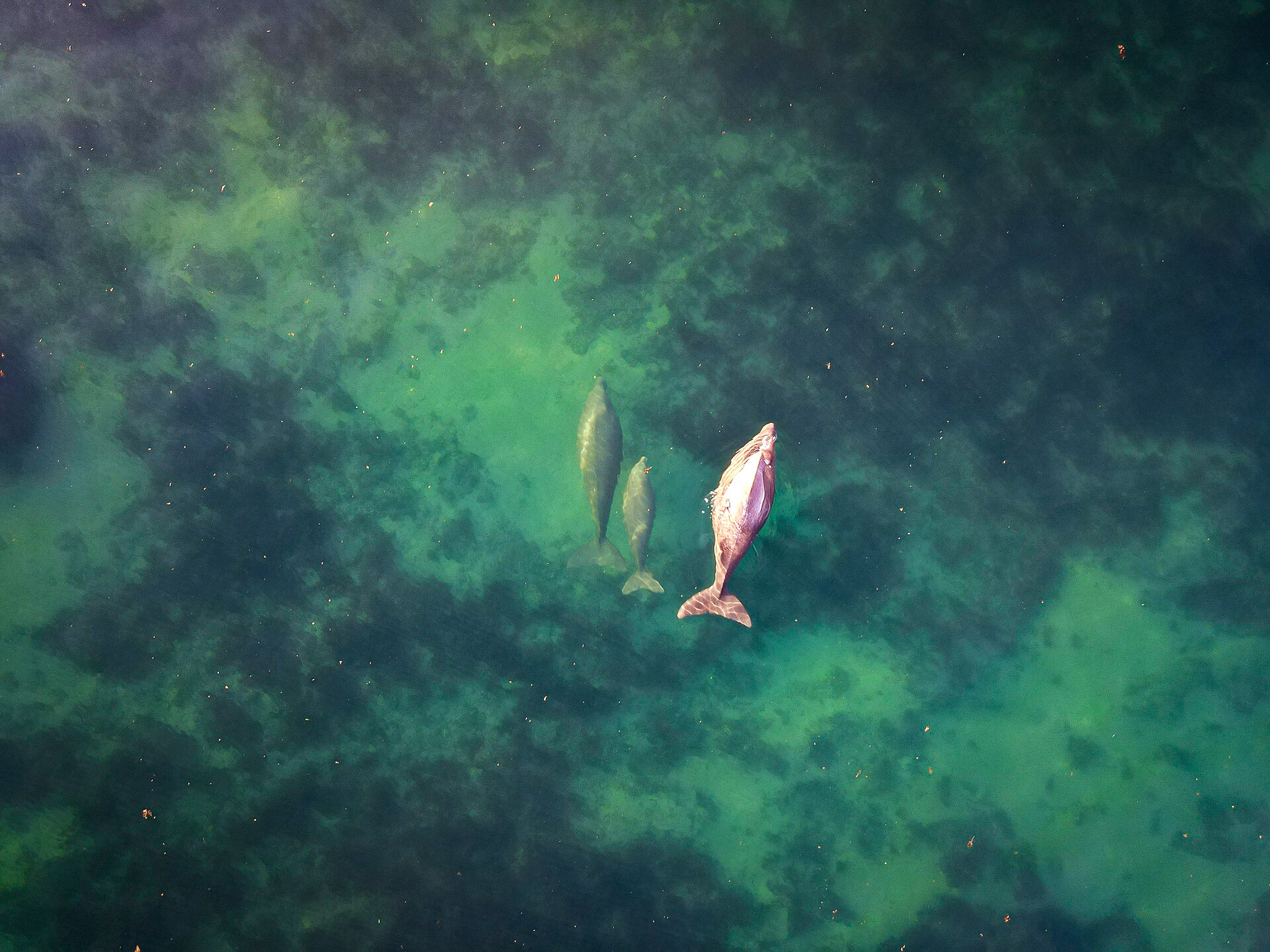
Dugongs — the gentle sea mammals long mistaken for mermaids. Photo: Nicocolll / CC BY-SA 4.0
When most think of mermaids, Disney's Ariel or some Hollywood version of the mythical creature — almost universally female — comes to mind. But historically, even eminent explorers from Christopher Columbus to Henry Hudson and John Smith reportedly encountered sea nymphs.
The traditional explanation asserts that sailors foolishly mistook Atlantic manatees or their Indo-Pacific cousins the dugongs — collectively, "sea cows" — for the beautiful creatures. But is it really likely that lonely sailors were so starved for companionship that anything remotely resembling a woman would dupe them? How drunk and lonely would a ship-bound Romeo need to be to mistake a sea cow for a sea nymph?
Beyond the sheer incredulity of this theory, there is something more problematic with it. "Mermaids are sort of beyond gender, given that they are half woman and half fish, often represented with no genitals, in a hybrid state," Carolyn Turgeon, author of five novels including Mermaid, tells The Diplomat. "Given our present moment, when gender is more fluid than it's ever been, I think mermaids have a particular resonance."
"At base, the mermaid is a hybrid, neither one thing nor another but everything at once."
The mermaid mythos — androgynous, universal — has been referenced from ancient Syria to classical Greece; Ireland to Babylon; in Africa and India, home of the mythical half-human, half-serpentine nagas. And while the myth was historically stronger in Europe, it turns out a more socially subversive interpretation has roots in Asia.
William Bond, co-author of The Origins of the Mermaid Myth, points out that a Dutch seaman called Hamel was shipwrecked near the Korean island of Cheju in 1653. He and the survivors spent 10 months there, observing something taboo at the time in both Korea and Holland: women diving for shellfish and edible seaweed. A similar practice was present in Japan, where reports of women free divers stretch back 1,500 years. In the 1960s, Western journalists photographed topless women divers capable of reaching 30 meters and spending up to three minutes submerged in 50-degree water. In China and Japan, these women were called "Dragon Wives," indicating their strength and stature in patriarchal societies.
In light of these facts, Bond asks: "Does this mean that what we refer to as mermaids are simply women divers?"
The full feature explores why the archetype resonates so strongly with women, the "essential feminine magic" of slipping into a tail — and, in a follow-up, a conversation with a real-life mermaid from the home of the Merlion, Singapore.
Continue reading at The Diplomat →